You check this month's orders and recognize a few names, but you don't know how many customers come back after their first purchase. Your repeat purchase rate tells you: it's the share of customers who have bought from you more than once.
To calculate it, divide the number of customers with two or more orders by the number of customers who have ever ordered, then multiply by 100. If 1,000 people have bought from you and 230 ordered again, your repeat purchase rate is 23%. WooCommerce doesn't show this rate in its reports, so you'll need to calculate it yourself or use a tool that does.
The repeat purchase rate formula
Repeat purchase rate = customers with 2 or more orders ÷ all customers × 100
Count each customer once, whether they've placed two orders or many more. You're finding out how many people returned to buy again.
Order totals alone can't tell you that. Imagine a store with a hundred orders from sixty people. Sixty were first orders, leaving forty repeat orders. Another store has a hundred orders from ninety-five people, so only five were repeat orders. Both stores had the same number of orders, but far fewer of the second store's orders came from returning customers.
You can measure the share of orders that come from returning customers too. Keep the customer calculation as your main number, though. A few people who order many times can account for a large share of your orders even when most customers never return.
Measure it the same way every time
The formula above includes every customer who's ever ordered. The all-time figure is useful as an overview, but older customers have had more time to return than newer ones. To see whether more of your new customers are coming back, compare groups who have all had the same amount of time to place another order.
- Group customers by the month of their first order. Choose a fixed amount of time to wait for a second order, such as their first 90 days. Then calculate how many customers in each month's group ordered again within those 90 days. You can compare this year's groups with last year's because every customer gets the same time to return.
- Wait until each customer's 90 days have passed. Someone who first ordered three weeks ago hasn't had the same chance to return as someone who bought months ago. Leave the newest customers out of the comparison until their 90 days are over.
- Match customers by email address. Guest checkouts don't create accounts. If you count by account, someone who checks out as a guest twice looks like two people who each ordered once. Group orders by email address so you don't miss those repeat purchases.
- Decide which orders count, then keep that rule. Leave out canceled and failed orders because they weren't purchases. You can choose whether to include refunded orders. Make that decision once and keep it, so a change in how you count doesn't look like a change in customer behavior.
When I first calculated this for my own store, I didn't like the result, and it changed which emails I wrote first.
What's a good repeat purchase rate?
A good rate depends on what you sell. Customers tend to reorder consumables and refills because they run out. Someone who buys a sofa can be happy with the purchase and have no reason to buy another for years. A percentage from another store won't tell you much unless that store sells similar products.
You can learn more by making two comparisons in your own store:
- Compare new customers from different months or years. Are this year's customers more likely to place a second order than last year's were?
- Compare customers who arrived before and after a change. After you introduced a welcome email, did a larger share of new customers buy again?
Give every group its full 90 days before comparing the results. Otherwise, a group may have more repeat buyers because its customers have had longer to return.
Our guide to what counts as a good repeat purchase rate looks at published figures by product category and explains what to keep in mind when comparing them with your store.
What to do to get more repeat purchases
1. Help customers place a second order
Start with customers who've bought once. Once they place a second order, you can begin using the emails and offers you send to regular customers.
Send a follow-up after the first purchase, timed to when the product is likely to run out or get used up. Give the customer one thing to do in that email. Our guide to how to get customers to order again explains when to send it.
2. Use the welcome email to introduce your store
The first email after a first order shows customers what to expect from your emails. Show what else you sell, explain how to reorder or get help, and give them a reason to keep reading.
If the email contains only a discount, customers learn that your emails are mainly a place to find discount codes.
3. Keep watching after the second order
A customer counts as a repeat buyer once they've ordered twice. Your repeat purchase rate doesn't distinguish between someone who returns ten times and someone who never buys again after that second order.
For repeat buyers, watch how long they go between orders. Your At-Risk customer group contains people who used to buy regularly but haven't ordered for a while. Our guide to what to send each customer segment explains how to email that group.
4. Sell products customers need after their first purchase
Refills, consumables, and add-ons give customers a reason to order again. Look at what customers bought after their first purchase of a particular product. You can use those purchases to choose a product to suggest to other customers who bought the same first item.
5. Check what you earn on discounted repeat orders
An ongoing offer of 20% off the next order can increase your repeat purchase rate. Some customers will return for the discount who wouldn't have ordered otherwise.
But if every second order comes with a code, customers can learn to wait for one. A repeat order with 20% off can still make money for your store, so check what you earn after the discount. Don't judge the offer only by how many extra orders it brings in. Don't use a discount that leaves you unable to cover the cost of the repeat order.
How Tendlio helps you bring customers back
Tendlio is a WooCommerce plugin that does these checks for you. Doing this by hand means grouping customers by their first purchase, checking who returned, and waiting before you compare the results. Then you need to find the customers who haven't returned and decide what to send them. Tendlio helps you measure repeat purchases and email the people you want to bring back.
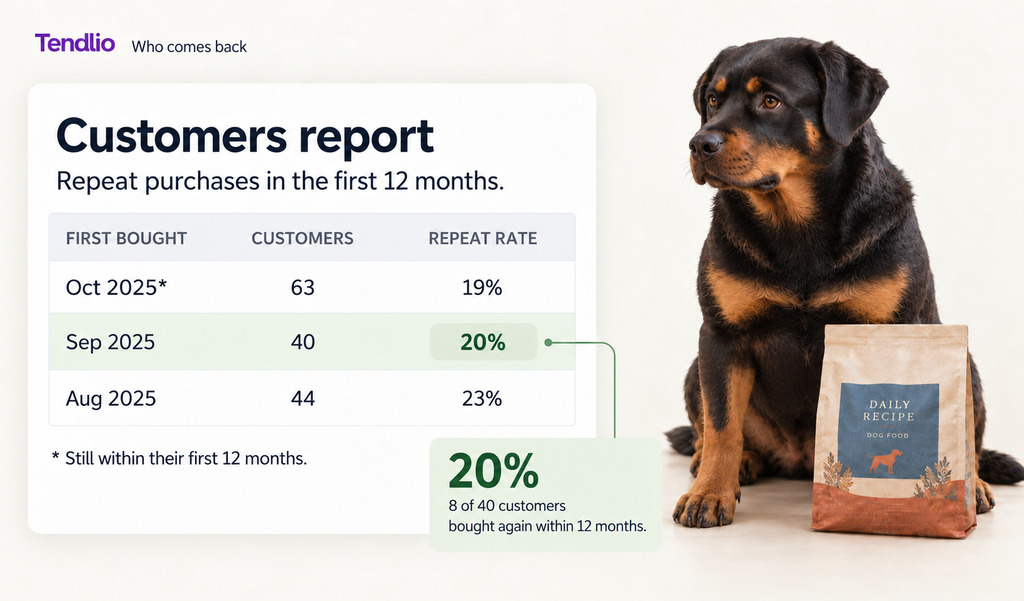
Your repeat rate, measured the way this guide recommends
The Customers report groups customers by the month they first bought:
- Repeat rate column. The share of each group that placed another order within their first 12 months. Twelve months is longer than the 90-day example in this guide, so expect higher percentages.
- A star on unfinished months. Newer groups that haven't had their full 12 months yet carry a small star, so you know which results are still changing. Compare the finished groups with each other.
- Once, twice or more. How many customers ordered once, twice, or more in the last 3, 6, 12 or 24 months.
A quick view on the Dashboard
The Repeat rate card shows what share of all orders came from returning customers, and you can add a Repeat orders card with the number of those orders under Customize cards. Both cards compare the current period with the previous one. The cards measure orders, while the Customers report compares groups of people who first bought in the same month. Use the report to judge how many new customers return, and the cards to follow how much returning customers contribute to your orders now.
Bring back the customers who haven't returned
- Email your one-time buyers. Tendlio regularly analyzes your store and sorts customers into groups. Open the one-time buyers group and email them from Campaigns. The newest customers with a single order stay in a separate New group until they've had time to return, following the same waiting rule you've used to measure your results.
- Ask for the second order. Tendlio can send a welcome email after the first purchase and a second-order nudge later. Once enough customers have come back, the Welcome & second order page shows how many days your customers take to place a second order and suggests when to send the nudge. Both emails skip customers who've already bought again, so you won't ask someone to place a second order they've already made.
- Suggest the right next product. The Customers report shows which product customers came back for after their first purchase, and a to-do card suggests a campaign to your one-time buyers that features that product.
- See when the mix of new and returning customers shifts. Your to-do list points out sharp changes in the share of orders from first-time buyers and names what to do next. When more new customers arrive, it directs you to set up the welcome email. When fewer arrive, it directs you to run a campaign to a customer group.
Want to see which customers come back, and email the ones who haven't? Start your free trial of Tendlio.
FAQ
What's the difference between repeat purchase rate and customer retention rate?
Repeat purchase rate tells you what share of customers have bought more than once. Customer retention rate tells you how many customers kept buying from one period to the next, for example how many of last quarter's buyers bought this quarter. Our guide to customer retention rate explains that calculation. For a small store, start with repeat purchase rate, because it's easier to calculate.
Should I calculate it from orders or customers?
Customers, because you want to know what share of people come back to buy again. The share of orders from returning customers answers a different question, and a few customers who order many times can change that figure a lot.
How do guest checkouts affect the number?
If you count customers by account, someone who buys as a guest twice looks like two customers who each bought once, and your repeat purchase rate looks lower than it is. Group orders by email address instead, which gives a closer count even though some people use more than one address.
How quickly can I expect the rate to move?
An all-time rate includes every customer who's ever ordered, so one better month makes little difference to it. If you group customers by the month of their first order, watch the group who first bought after you made the change. Collecting that group takes a month and their 90 days to return come after, so you can judge the result about four months after the change.
Is a low repeat purchase rate always a problem?
No. If you sell something people may only need to buy once, such as a sofa or a bike, happy customers may have no reason to order again. A low rate is a problem when you sell products people would normally reorder, but almost nobody does, and in that case a follow-up after the first purchase can help.